

A practical four-part workshop for allied health clinicians working with children and young people
From Understanding to Action:
Supporting Executive Functioning in Clinical Practice
A workshop designed to help you move beyond knowledge of executive function strategies, and start creating and applying supports that actually stick in everyday practice.
Delivered online across four sessions:
5 Aug, 12 Aug, 26 Aug, 2 Sept 2026
1:00–2:30pm (Melbourne, Australia)
MISSED THE LIVE SESSIONS?
Click below to join the waiting list for the upcoming on-demand course
This is for you if:
You are working with children or young people who struggle with organisation, planning, time management, regulation, or follow-through in everyday tasks
You recommend executive function strategies, but they don’t stick, or are resisted
You find it difficult to engage clients in therapy sessions when creating strategies, or to build motivation to use strategies
You find yourself cycling through strategies without seeing consistent or meaningful change
You understand executive functioning concepts, but you’re not always sure which strategies to use, when to use them, or how to adapt them for a specific child or context
You may be early in your executive function work, or experienced but feeling stuck when strategies aren’t working
You want approaches that are practical, adaptable, and grounded in neuro-affirming practice
Why this feels hard
If this resonates, you’re not doing anything wrong.
Most clinicians are only taught the basics of executive function development during training. Beyond a general understanding and a handful of environmental modifications or strategies, there is often little guidance on how to actively support and develop these skills in practice.
So it makes sense that when working with children and young people with executive function differences, the default approach is to recommend strategies or environmental supports.
But in practice, these often don’t stick. Or they don’t lead to the change expected.
I know, as this is where I used to feel stuck in my own work!
In reality, environmental strategies are only one part of executive function intervention. Research, including the work of Adele Diamond, highlights there are multiple and interacting factors which make executive function interventions more effective, including:
Whether supports are implemented within the child’s everyday environment (to promote generalisation of skill)
Practice and challenge in using executive functions
The child’s engagement and motivation in applying any changes
Addressing stressors and mood
A collaborative therapeutic relationship between the child and clinician
Explicit teaching of meta-cognitive processes
Without a clear way to bring these elements together, it can be difficult to know what to prioritise, how to adapt, or why something isn’t working.
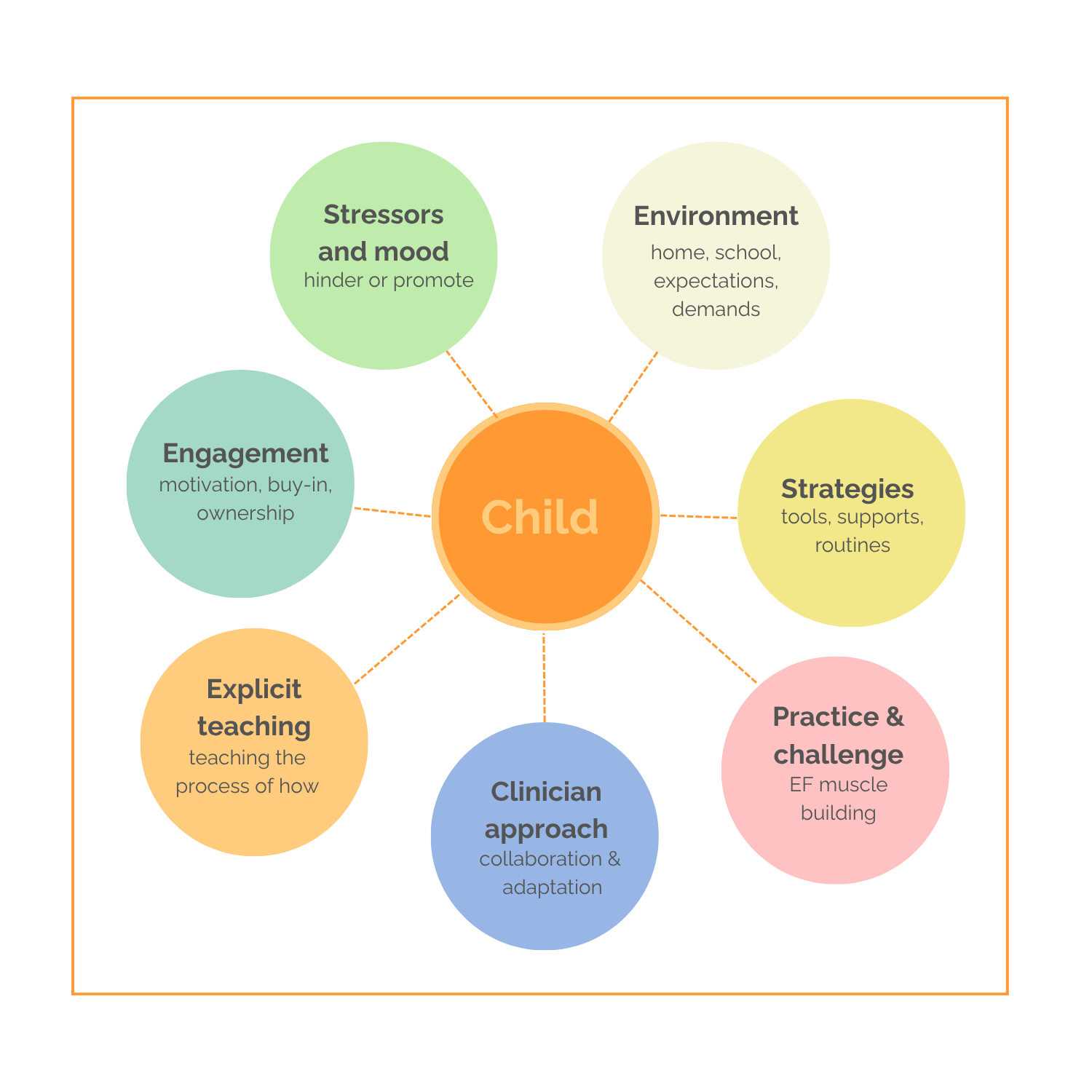
Effective EF support sits at the interaction of these elements - not in the strategy alone.
“From Understanding to Action:
Supporting EF in Clinical Practice”
This workshop is designed to help you move from feeling stuck, to confidently applying your executive functioning knowledge in your clinical work.
Across four sessions, the focus is on helping you to:
Understand executive functioning in the context of the child and their environment, and why a one-size-fits-all approach rarely works
Identify the underlying “why” behind executive function differences, so you can target the right areas for support
Work with the child to co-design strategies with the child that are aligned and motivating for them, and fit their environment and goals
Support implementation in a way that increases follow-through and helps strategies hold in everyday life
Work collaboratively with children and parents to build engagement, motivation, and shared understanding
Use a structured executive function framework to guide assessment, intervention, and review
You will also develop practical skills in how to:
set collaborative and meaningful goals with children and families
create strategies with the child, rather than for them, as part of a collaborative problem-solving process
adapt and refine strategies based on what is (and isn’t) working
support children to understand and engage with their own executive functioning
How this approach is different
This is not a workshop that focuses on giving you more executive function strategies.
It focuses on understanding how to make strategies work - in a way that fits the child, the context, and everyday life.
The approach is grounded in:
Clinical reasoning - understanding what is driving the difficulty, and what needs to change
Real-world application - linking intervention directly to the child’s everyday environments and demands
Adaptability - shaping strategies to fit the individual, rather than applying the same tools across clients
Collaboration - using collaborative problem-solving as the foundation for intervention, rather than simply prescribing strategies
Sustainability - creating supports that can realistically be used and maintained over time
Because strategies only work if they can be used, consistently, in real life.
What you’ll leave with
By the end of the workshop, you will have:
A clearer process for understanding how executive function differences are showing up in a child or young person’s everyday life
Greater confidence in identifying what is driving these differences, and what to target in intervention
Practical ways to design and adapt strategies so they are more likely to be used and maintained
A structured framework you can use across assessment, intervention, and review
Tools to support strategies transferring into home, school, and daily environments
Greater confidence engaging children and families in the process, and building motivation for change
Meet your facilitator

Dr. Ruth Tesselaar
Clinical Neuropsychologist and Founder of Dandelion Hub
Ruth has over 20 years' experience working with neurodiverse children and families, and has practised as a Clinical Neuropsychologist for 16 years, including at the Royal Children's Hospital, Melbourne.
She founded Dandelion Hub in 2021 with a focus on making executive function support practical, accessible, and meaningful in everyday life.
Her work centres on helping clinicians and families move beyond strategies that don’t translate, toward approaches that are more aligned, collaborative, and sustainable.
Ruth is an experienced workshop facilitator, with a background spanning hospitals, schools, and tertiary education settings.
Who is this workshop for?
This workshop is designed for allied health professionals working with children and young people aged 4 to 21 years, including (but not limited to!):
Occupational Therapists
Psychologists, Neuropsychologists, Educational Psychologists, Clinical Psychologists….
Speech Pathologists
Counsellors and other therapists
It is particularly relevant for clinicians working with neurodivergent individuals, including ADHD, autism, acquired brain injury, oncology history, learning differences, and executive function differences.
This workshop is a good fit if you:
have a basic working understanding of executive functioning, but want to move from theory to confident, practical application
provide, or want to provide, executive function assessment, feedback, and/or intervention as part of your clinical work
want to improve engagement and follow-through with strategies
are looking for practical, clinic-ready approaches that can be adapted across clients
This workshop is suitable for both early career and experienced clinicians wanting more consistency in their outcomes.
The workshop includes:
Six hours of professional development, delivered across four 1.5-hour sessions
A combination of teaching, case examples, and guided application
Opportunities to reflect, apply ideas to your own clients, and work through scenarios using a structured workbook
Resources to support implementation beyond the sessions
Access to session recordings for two months
A small group format (maximum 25 participants) to support discussion and application
A PD certificate
Attendance at the live sessions is strongly recommended to support learning and application, although recordings will be available.
Workshop format
Investment and dates
DATES
This workshop is delivered across four sessions:
Wednesday 5th August 2026
Wednesday 12th August 2026
Wednesday 26th August 2026
Wednesday 2nd September 2026
Time: 1:00–2:30pm (Melbourne, Australia)
Format: Online (Zoom)
Each session builds on the previous one, with space between sessions to reflect, trial ideas, and bring back questions.
TOTAL INVESTMENT:
$350 (inc GST, booking fee applies).
This includes:
Four live workshop sessions (6 hours total PD)
Access to session recordings for two months
A structured workbook to support application
Practical tools and frameworks for ongoing clinical use
Executive function strategy guide
A PD certificate
This is a small group workshop (maximum 25 participants) to support discussion, reflection, and application.
Registrations close 2nd August 2026, or earlier if all places are filled.
Not sure if this is the right fit?
That’s okay.
If you’d like a better sense of how I approach executive function intervention, you can watch my free 50-minute webinar:
Making Executive Function Interventions More Effective: A Process-Based Approach for Clinicians
This will give you a clear idea of how I work, and whether this workshop aligns with your clinical practice.
Or, if you know this is what you’re looking for:
Supporting executive functioning sits at the intersection of the individual, their environment, and how they actually engage with strategies. Not just the strategies themselves.
Supporting executive functioning isn’t about having more strategies.
It’s about knowing how to work collaboratively with your clients to select, shape, and apply support in ways that hold in real life.
This workshop is designed to help you do that with greater clarity and confidence.
If you are ready to move from feeling frustrated that your strategies are not sticking, to creating and applying effective executive functioning supports, then register your spot today.
Places are limited 25 participants, and registrations close 2nd August 2026, or earlier if all places are filled.
Frequently Asked Questions
-
Yes. All sessions are delivered live via Zoom.
-
No. This is one workshop delivered across four sessions, designed to give you time to reflect, trial ideas, and apply your learning between sessions.
-
No worries! While ideally you would attend all sessions live to make the most of the interactive components, I understand that life happens. You will be able to catch-up on any missed sessions through the video replay.
-
Yes. All sessions will be recorded and available to participants for two months following the final session.
-
Melbourne, Australia time.
-
Yes. The workshop draws on current research and neuro-affirming practices.
-
Yes, however, each participant is required to register and pay individually.
-
Due to the small group nature of this workshop, refunds are not available once your place is confirmed.
If you are unable to attend, you will continue to have access to the session recordings for two months following the final session.
If something unexpected comes up, you are welcome to get in touch to discuss transfer options where possible.
Have further questions? Reach out via email using the button below.